
 +65 3138 7820

Kingdee AI Suite Launches Singapore LocalKits | Built on Compliance, Adapted to Local Business
In recent years, with its mature business ecosystem and well-established regulatory environment, Singapore has become a key hub for Chinese enterprises expanding overseas—serving as a financing and investment hub, a base for overseas headquarters, and a springboard for international growth. Meanwhile, aligned with the OECD’s “Tax Administration 3.0” Singapore is accelerating toward digitalized tax processes, more structured data, and real-time traceability.
For companies establishing a regional headquarters, a trading entity, or a service entity in Singapore, the earlier e-invoicing, Goods and Services Tax(GST), and Corporate Income Tax(CIT) compliance are embedded into business workflows and system rules, the easier it becomes to turn compliance work into operational efficiency and greater predictability.
To help Chinese enterprises establish compliant operations in Singapore faster, Kingdee AI Suite introduces the LocalKits Finance and Tax (Singapore)—a localized compliance solution covering financial accounting, InvoiceNow connectivity, tax determination at the transaction stage, and tax filing.

Key Considerations for Finance & Tax Operations in Singapore
1、Accounting and bookkeeping
Singapore adopts Singapore Financial Reporting Standards (SFRS), which are closely aligned with IFRS. Companies generally file financial statements with the Accounting and Corporate Regulatory Authority (ACRA) (unless exempt). Some entities must also file a full set—or key financial data—in XBRL format, ensuring consistent reporting definitions and auditable, verifiable data.
2、E-invoicing
Singapore promotes e-invoicing through the globally adopted Peppol framework, locally known as “InvoiceNow.”IRAS has announced a phased rollout of the relevant requirements and require invoice data to be submitted to IRAS via the InvoiceNow network. Some newly incorporated businesses that voluntarily register for GST are already in scope. E-invoicing gradually shift from a productivity tool to essential compliance infrastructure.
3、Goods and Services Tax (GST)
Singapore’s standard GST rate has been 9% since 2024. Businesses generally must file and pay within one month after the end of each accounting period, and a nil return is still required even when there is no activity. Extensions are generally not granted. Following the rollout of InvoiceNow, GST compliance will rely more heavily on systematic automated data extraction and consistency verification.
4、Corporate Income Tax (CIT)
Singapore’s CIT rate is 17% (with supporting relief measures). Typical requirements include filing Estimated Chargeable Income (ECI) within three months after the financial year end, with the annual filing deadline generally on 30 November. Singapore has also confirmed implementation rules for Pillar Two (the Global Minimum Tax), with registration starting in May 2026—so in-scope multinational groups should assess the impact early and prepare for registration and reporting within the required timelines.
Kingdee AI Suite: Built on Compliance, Adapted to Singaporean Business
1、Localized finance templates: ready out of the box and aligned with local standards
Kingdee AI Suite comes with preconfigured charts of accounts, reporting items, and report templates aligned with local accounting standard. It also supports customer-specific configuration, significantly reducing setup and configuration work. The presets are available in both Chinese and English, making bilingual reporting more efficient for enterprises balancing local operations and group management.
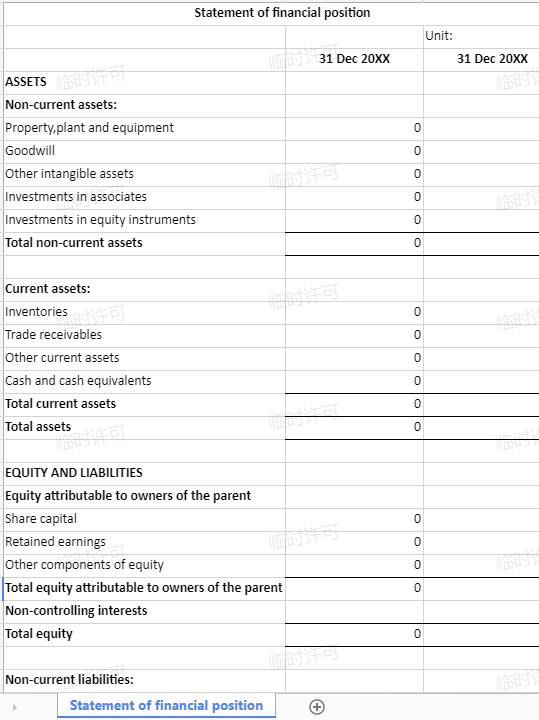
In addition, the system includes commonly used document templates—such as Customer Statements and Sales Invoices—to improve day-to-day efficiency.
2、InvoiceNow connectivity: end-to-end e-invoicing across core business scenarios
Kingdee AI Suite supports invoice issuance within the ERP and integrates with third-party service providers to deliver e-invoices over the InvoiceNow network. Issuance status and invoice details are automatically synchronized back to the ERP, forming a traceable closed loop. It supports common invoicing scenarios based on sales and purchase invoices, including discounts/allowances, returns, and invoice corrections. Capabilities such as issuance requests, compliance validations, merge/split, de-duplication, and correction checks move validations upstream and help reduce compliance risk.
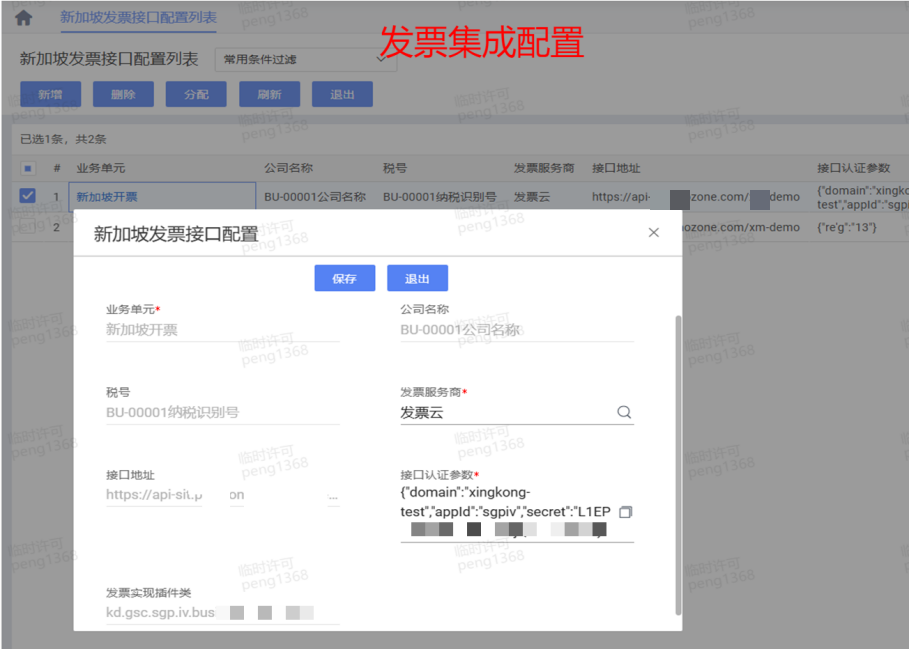
3、Tax calculation engine: codified logic with one-stop tax determination and filing
Kingdee AI Suite meets the technical requirements associated with IRAS Accounting Software Register Plus (ASR+) and aligns with the recommended digital capability framework. At the transaction stage, the system automatically captures key attributes—such as place of supply, products/services, and tax status—then performs tax determination and calculates key elements including tax type, rate, and amount. This provides data for GST return preparation at period end. For CIT, it supports automated tax computation based on configurable data rules, and enables preparation, review, and export of the annual CIT return (Form C-S). By codifying rules and maintaining an audit trail, it reduces manual consolidation and repeated reconciliations, significantly lowering the cost of compliance.
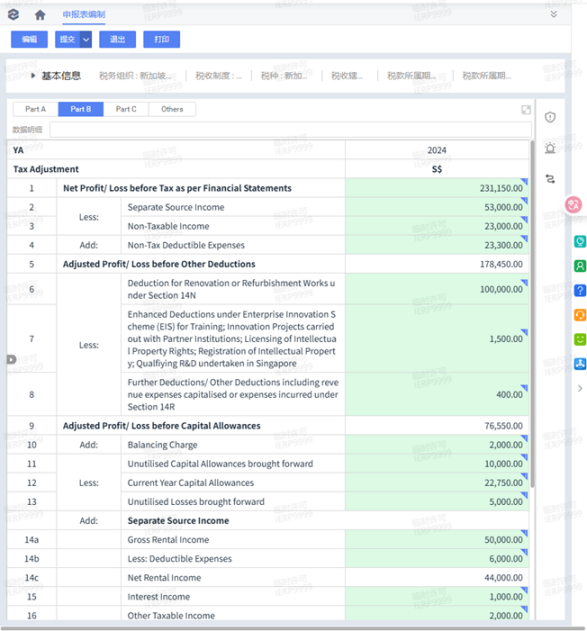
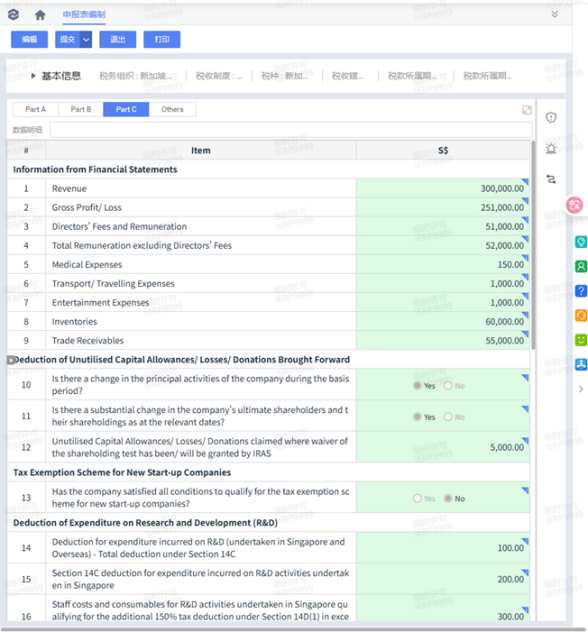
As Singapore’s tax administration becomes increasingly digital, resilient operations depend on shifting compliance upstream into workflows and system rules—ensuring invoice–ledger–tax consistency with traceable, single-source data. Built on localized finance templates and InvoiceNow e-invoicing, the LocalKits Finance and Tax(Singapore) helps enterprises respond to regulatory upgrades with lower compliance costs and higher filing efficiency. With compliance as the foundation, companies can operate in Singapore with confidence—and a stronger compliance base brings more stability in global operations.